How Commercial Floor Coating Differs
A commercial floor carries forklifts, chemicals, hot water or aircraft rather than a family car, so the system changes. Thicker builds, chemical-resistant topcoats, urethane cement and joint fillers come into play, and the schedule has to work around a building that cannot simply close for three days.
Warehouse Floors Along I-55 and Weber Road
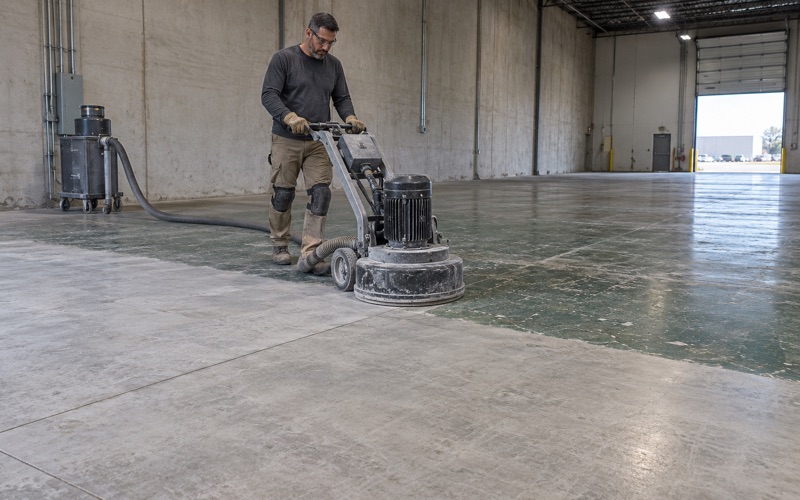
The distribution buildings along I-55 and Weber Road include 1601 Remington Boulevard, listed at 591,748 square feet with 59 exterior docks. Floors on that scale are coated in sections planned around racking rows, aisles and the dock schedule, so receiving and shipping keep running while each section cures.
Control Joint Filler Under Forklift Traffic
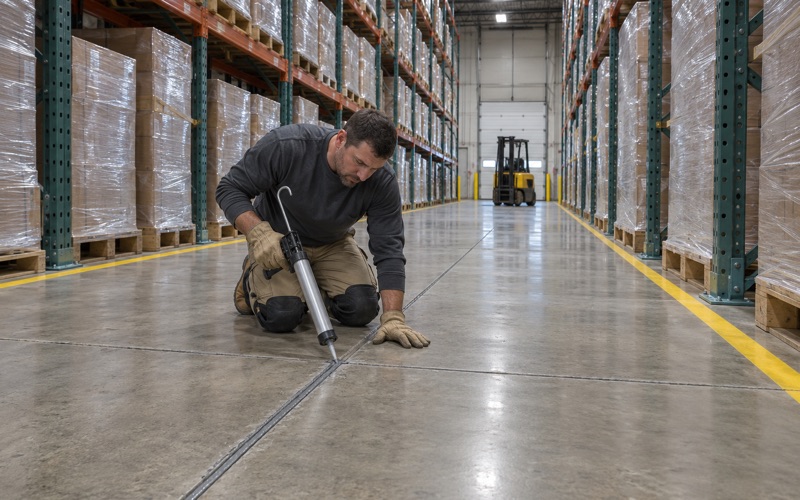
Control joints chip at the edges as forklift wheels drop across them, and a coating bridged over a joint cracks along its line. We clean the joints and fill them with a semi-rigid polyurea joint filler that supports the edges under wheel loads, then coat up to the joint.
Aisle Striping and Safety Marking
Aisle lines, pedestrian walkways and forklift lanes are applied as part of the coating system so they wear with the floor. We lay out stripes from your plan and site conditions rather than from a rule, since federal standards specify no stripe width or color for aisle marking.
Restaurant Kitchens and Will County Plan Review
Under the Will County Food Establishment Sanitation Ordinance, plans including finish materials must be approved in writing before the village issues a building permit for a food business. We specify the floor to pass that review the first time, which keeps a kitchen remodel on schedule.
Urethane Cement and Coved Bases for Hot Washdown
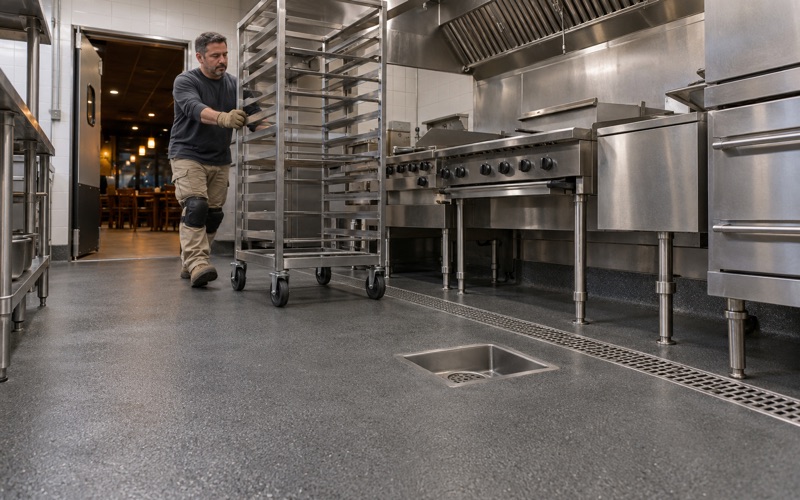
Hot water and steam cleaning soften standard epoxy, and thermal cycling can pull it off the slab. Food floors that see washdown get urethane cement, which tolerates thermal shock, carried up the wall as a coved base so the floor-to-wall joint is sealed and cleanable as the FDA Food Code expects.
Hangar Floors at Clow International Airport
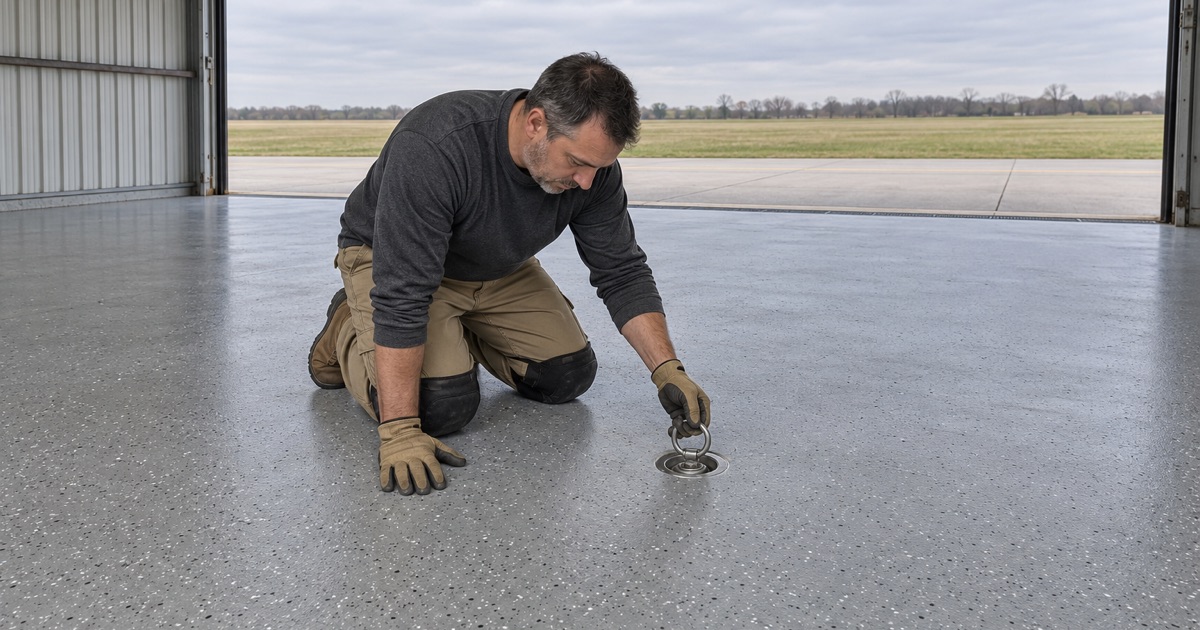
Clow International Airport is owned by the Village of Bolingbrook, and its hangars hold aircraft that drip fuel and hydraulic fluid onto the slab. Hangar floors get a chemical-resistant system with a light, reflective finish, so leaks show quickly and fluids clean up without soaking into the concrete.
Storefront and Tenant Space Floors
Retail and office tenant spaces often turn over with a short window between leases. We grind out old adhesive and coatings, repair the slab and install a polished or coated floor inside that window, so the space is ready for the next tenant’s fixtures on the date agreed.
Auto Repair Bays and Lift Anchors
Repair bays see motor oil, coolant, brake fluid and lifts bolted into the concrete. We coat around existing lift anchors and plates with a chemical-resistant system, and where lifts will be installed later, we coordinate the anchor locations so the coating is not drilled through after it cures.
Static-Dissipative and ESD Floors
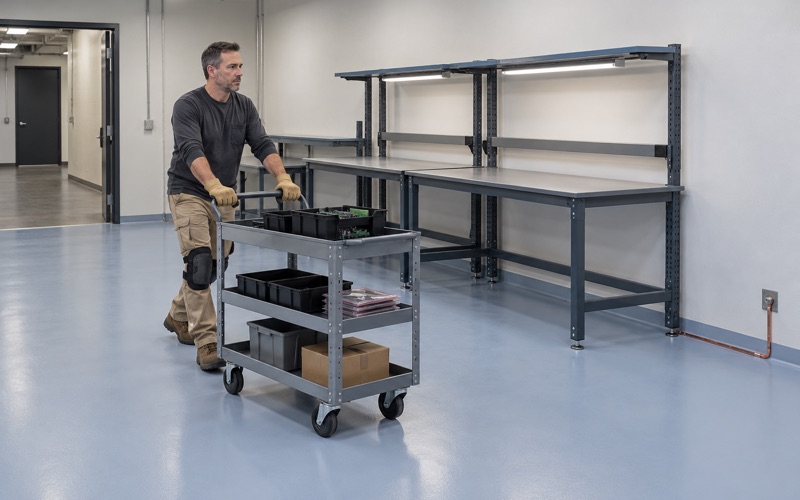
Electronics assembly, data rooms and some labs need a floor that drains static charge within a specified resistance range. An ESD floor uses conductive primers, grounding points and a static-dissipative topcoat, and we test resistance after install so the result is measured rather than assumed.
Illinois VOC Limits on Floor Coatings
Illinois caps volatile organic compounds in floor coatings at 250 grams per liter and in industrial maintenance coatings at 340 under 35 Ill. Adm. Code Part 223, statewide. Unlike the federal rule, it binds the contractor who applies the coating, so we choose compliant products and never thin them past their limit.
Overnight and Weekend Floor Installs
Shops, stores and kitchens that cannot close during business hours get their floors in overnight and weekend windows. We set the system and cure time to fit the window, including fast-cure polyaspartic topcoats where a floor has to return to service the next morning.