Bolingbrook Epoxy Flooring has spent 20+ years installing floor coatings in Bolingbrook, IL, and polyaspartic floor coating is now part of most systems we put down, serving surrounding cities including Lemont, Warrenville, Burr Ridge, Hinsdale and Shorewood. Polyaspartic is an aliphatic polyurea that cures fast, stays clear in sunlight and stays tougher under abrasion and hot tires than most epoxies.
Fast cure is the selling point and the risk. A coating that sets in minutes leaves no room to fix poor preparation, so every polyaspartic floor we install starts the same way as any other: diamond grinding, a moisture test, and crack and joint repair before any resin is opened.
The proposal states whether polyaspartic is the whole system or the topcoat over an epoxy base, with each layer’s product and finished thickness named, so you can tell what you are paying for.
Where Polyaspartic Coatings Earn Their Place
Residential Garages
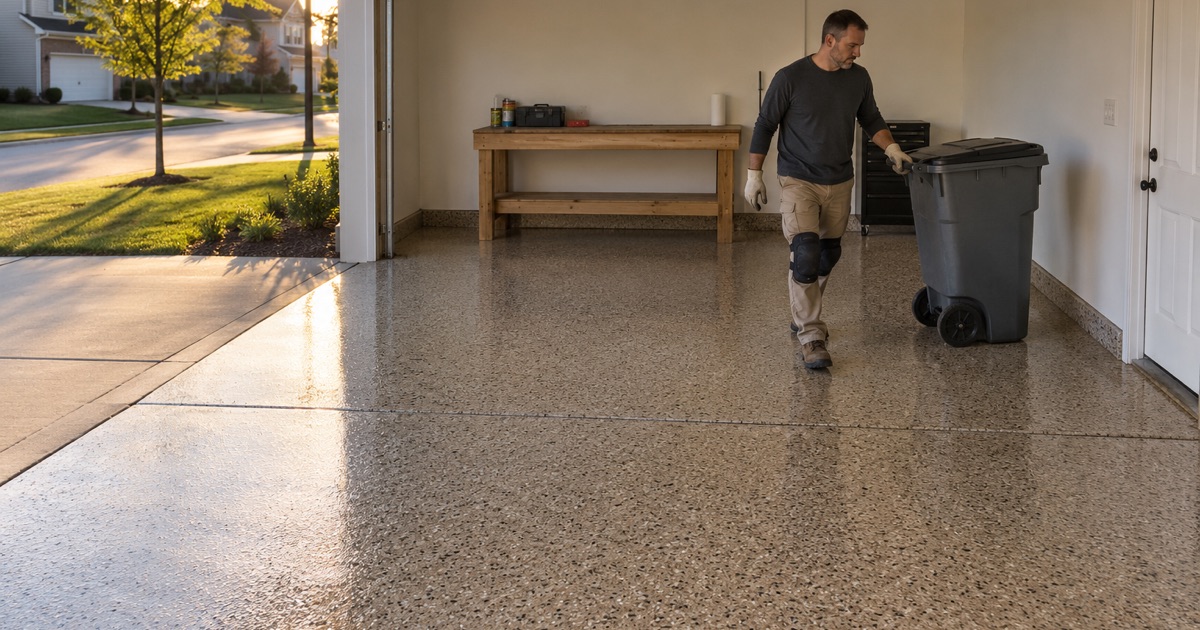
Garages are where polyaspartic does the most good. The open door lets sunlight onto the front of the slab, where epoxy would amber, and cars bring in hot tires and salt brine all winter. A polyaspartic topcoat over a flake broadcast resists both, and its abrasion resistance keeps the floor from dulling in the wheel paths.
The fast cure also matters at home. Most households cannot do without the garage for days, and a polyaspartic system can often be ground, coated and sealed in one day, with cars back on it after the cure time the product sets for the slab temperature.
Shops, Showrooms and Storefronts
Retail and showroom floors near large windows benefit from a topcoat that holds its color in sunlight. Shops that cannot close long are good candidates too, because a polyaspartic section installed overnight can take foot traffic the next morning.
Storefronts around retail centers such as The Promenade Bolingbrook run long hours and short closures. A polyaspartic system lets us grind, coat and seal a small sales floor between closing and opening, with fixtures moved back once the topcoat reaches the traffic stage its maker specifies.
Commercial and Light Industrial Floors
In warehouses, auto bays and service areas, polyaspartic and polyurea topcoats add chemical and abrasion resistance over an epoxy base. We match the topcoat to the chemicals the floor actually sees, from motor oil and coolant to cleaning agents, using the product data rather than a general claim of chemical resistance.
On larger floors the fast cure turns into scheduling room. A warehouse aisle or a service bay can be coated in a weekend section and returned to forklift or vehicle traffic sooner than a slow-curing epoxy topcoat would allow, which keeps a building shipping while the floor is renewed in phases.
Polyaspartic Compared With Epoxy
Color Stability Under Ultraviolet Light
Epoxy ambers when ultraviolet light reaches it, starting as a yellow cast in front of a door or window. Aliphatic polyaspartic does not, so it is the layer we put on top wherever sunlight reaches the floor.
The difference is easiest to see on a light gray or white floor, where a few seasons of afternoon sun through a garage door can leave a yellow band across an epoxy topcoat. Under a polyaspartic topcoat the color at the door matches the color at the back wall.
Cure Speed and Working Time
Polyaspartic can reach light foot traffic in hours, against roughly a day for many epoxies. The trade is a short pot life, especially on a warm slab, which is why it takes a crew that mixes small batches and works the floor in sections.
Pot life is a curve against temperature rather than a fixed number: the same material that gives a comfortable working window on a cool slab can set far faster on a warm one. That is why we read the slab before mixing instead of following a time printed on a sales sheet.
Hot Tire Pickup
Hot tire pickup is a coating softening under a warm tread and lifting with it, usually where a thin product sits on poorly prepared concrete. A hard, well-cured polyaspartic topcoat over a ground slab and a full-thickness base is one of the most reliable ways to prevent it, because it gives the tire nothing soft to grab.
Bond and Build
A 100% solids epoxy base wets deep into a ground surface and builds thickness economically, which is why we often use it as the base coat. Polyaspartic then provides the wear surface. On slabs where speed matters most, a full polyaspartic system with a matching primer is also an option.
Flexibility and Temperature Range
Polyaspartic stays more flexible than most epoxies, so it handles temperature swings in an unheated space better, and it can be applied over a wider range of slab temperatures. That does not make it a winter product for a frozen slab: the concrete still has to be dry and above the dew point.
Installing a Polyaspartic Floor Correctly
Grinding to Profile
Polyaspartic gives preparation shortcuts no time to hide. We grind every slab with diamond tooling to the ICRI surface profile the system calls for, collecting dust at the grinder, and we never acid etch.
Old garage paint, store-bought kit coatings and penetrating sealers all have to come off, because a fast-curing system bonds only to what it touches. Grinding also opens the cracks and spalls for repair, so the coating goes onto one continuous, sound surface.
Moisture Testing First
A fast-curing coating is just as vulnerable to vapor coming up through a slab as a slow one. We test with a calcium chloride test or in-situ relative humidity probes, and where the slab reads high we specify a moisture-mitigation primer under the system.
Garage slabs deserve particular care here. The model residential code does not require a vapor retarder under a garage, and the village’s own detached-garage specification lists none, so a one-day garage floor still waits on a test result rather than on the assumption that the slab is dry.
Reading Temperature and Dew Point
Before each coat we measure slab temperature, air temperature and humidity, and confirm the slab surface is safely above the dew point. Condensation under a coat that cures in minutes cannot be wiped away, so the readings decide whether we start that day.
Mixing in Small Batches
We mix polyaspartic in batches sized to what the crew can place within its pot life on that day’s slab temperature. Each section is rolled out, broadcast and back-rolled before the next batch is opened, so there are no lap marks from material that began to set in the bucket.
Broadcast and Back-Rolling
On a flake system, chips are broadcast into the wet base until it will take no more, then the loose flake is scraped and vacuumed once the base has set. That leaves a fully covered, textured surface that the clear polyaspartic topcoat locks in place.
The topcoat is applied with a squeegee and back-rolled to an even film, with extra attention at the edges, the step to the house and around drains. Thin spots at the perimeter are where wear and salt show first, so the edges get the same build as the middle of the floor.
Return to Service
We give you two times in writing: when the floor can take foot traffic and when it can take a vehicle or a loaded cart. Both come from the product data and the slab temperature on the day, and on a cool slab both run longer, which we would rather tell you than have a car parked on a topcoat that is still soft.
Warranty, Odor and VOC Questions
What a Coating Warranty Excludes
Coating warranties commonly exclude failures caused by moisture vapor or hydrostatic pressure from below, new cracks from slab movement, and damage from impacts or chemicals outside the product’s rating. We read those exclusions to you before you sign, with moisture first, because it is the one that matters most.
Illinois VOC Limits
Illinois limits the VOC content of floor coatings under 35 Ill. Adm. Code Part 223, and the rule binds whoever applies the coating as well as whoever makes it. We use compliant polyaspartics and do not thin them beyond what the label allows.
That matters more in this region than the national rule suggests. The federal architectural coatings rule binds manufacturers, while the Illinois rule also reaches the contractor on site, and the Chicago area is classed as a nonattainment area for the 2015 ozone standard, which is why solvent content gets attention here.
- 20+ Years Coating Concrete
- Moisture Testing in Every Scope
- Free Written Estimates