
Bolingbrook Epoxy Flooring has spent 20+ years on concrete floor repair in Bolingbrook, IL, serving surrounding cities including Lemont, Warrenville, Burr Ridge, Hinsdale and Shorewood. Most of our repair work happens as the first stage of a coating job, because no epoxy or polyaspartic system lasts on a cracked, scaled or spalled surface, but we also repair floors that will stay bare.
Every repair starts with reading the slab. We look at how wide each crack is, whether its edges sit level, how the joints have worn, where salt has scaled the surface and what old coatings are hiding, and then we separate what can be repaired from what cannot.
That second category matters. When a slab has settled, heaved or is draining toward a house, we say plainly that it needs lifting or replacement before any surface repair or coating will hold, rather than filling cracks that will open again.
Crack Repair for Concrete Floors
Hairline and Shrinkage Cracks
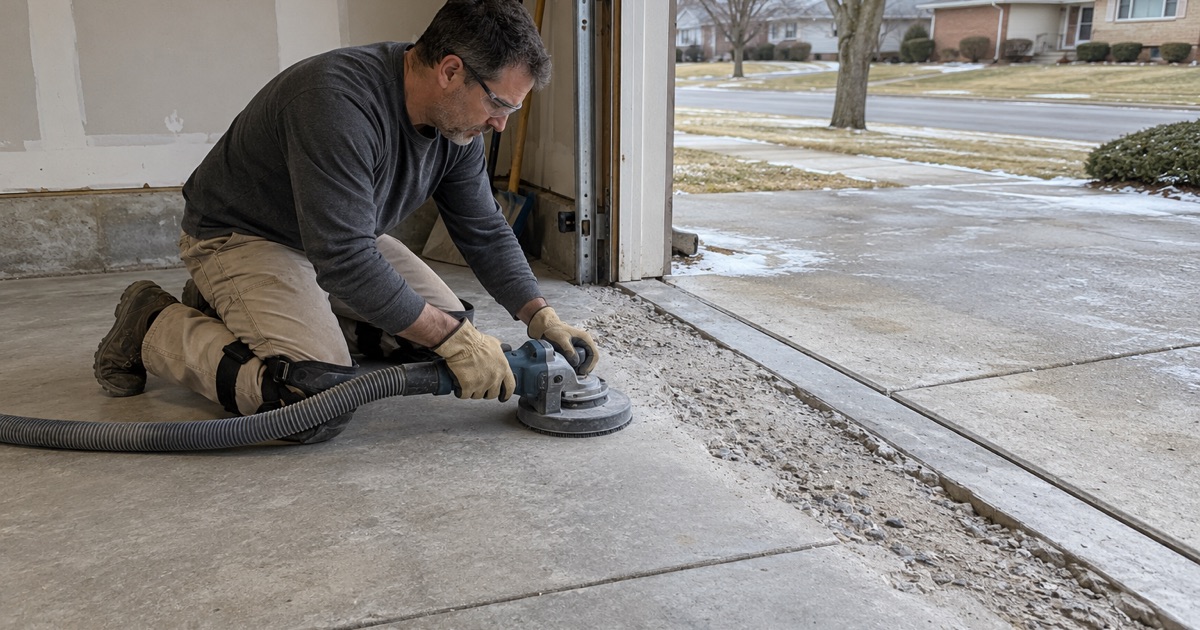
Thin cracks that appear as concrete cures are the most common thing we repair. We grind across them with diamond tooling, chase them open so filler can get in, then fill with an epoxy or polyurea crack filler and grind it flush with the slab.
Opening the crack is the important part. Smearing filler over a hairline crack leaves a thin skin that pops loose, while a chased crack holds a solid bead of filler bonded into both sides.
Wider Cracks and Displaced Edges
Cracks wider than a hairline are cleaned of debris and loose concrete before filling, and deep ones may be filled in stages. Where one side of a crack sits higher than the other, we grind the high edge down so a coating or foot traffic does not catch on it.
A displaced crack also tells us the slab moved at some point. We check whether it is still moving before recommending a rigid repair, because a crack that is still active will reopen through anything rigid placed in it.
Cracks Under a Coating
When a floor will be coated, we decide crack by crack whether to fill rigidly or to treat the crack as a joint. A rigid repair makes a seamless floor; honoring an active crack with a flexible filler lets the slab keep moving without a line appearing in the new coating.
Spalls, Pitting and Salt Scaling
Garage Floor Scaling From Road Salt
The flaking, pitted surface near a garage door is usually salt scaling. Calcium chloride brine tracked in on tires soaks into the top of the slab, and the compound it forms with concrete at temperatures between roughly 32 and 122 degrees weakens the surface paste until it flakes away.
We grind off the weakened layer until sound concrete shows, then rebuild the low areas with an epoxy mortar. A coating over the repaired slab keeps the brine on the surface from then on.
Spalls and Popouts
Spalls are pieces of the surface that have broken away, often at joint edges or where something heavy was dropped. Popouts are small cone-shaped holes left when a piece of aggregate near the surface breaks loose. Both are cleaned out, primed and filled with an epoxy mortar troweled level.
Pitting and Rough Surfaces
A slab that has worn rough across a large area may need a skim coat rather than spot repairs. We grind first, then apply an epoxy skim coat that fills the pits and gives a smooth base for the system that follows.
Joint Repair and Joint Filling
Worn Control Joints
Control joints are cut into slabs so cracks form where they are planned. Their edges chip under wheels and carts over time, especially in shops and warehouses. We clean out failed filler, rebuild broken edges with an epoxy mortar and refill the joint.
Semi-Rigid Polyurea Joint Filler
In floors with forklift or cart traffic, we fill joints with a semi-rigid polyurea joint filler that supports the edges under wheel loads. It is flexible enough to tolerate small seasonal movement but firm enough to stop the edges from breaking down.
On warehouse floors along I-55 and Weber Road, where a single aisle may have a joint every few feet, this repair is often worth doing even where no coating is planned. Chipped joints are what make forklifts jolt and loads shift.
Rack Anchors and Patches
Relocated racking leaves anchor holes and broken concrete behind. We fill old anchor holes, repair damage around baseplates and patch trenches where utilities were cut in, so the slab is continuous again before the floor is coated or polished.
Repair Before a Coating Goes Down
Removing Old Coatings and Failed Patches
Old paint, failing coatings and loose patches have to come off before repairs can bond. We remove them by diamond grinding or shot blasting, never acid etching, and collect the dust at the machine so it does not end up in a floor drain.
Moisture Testing Before Repair Materials
Epoxy repair mortars and fillers are affected by moisture just as coatings are. We test the slab before repairs on any floor that will be coated, so the repair materials and the primer are matched to what the slab is doing.
What Repairs Cost
Repair is priced as separate line items: crack filling by the linear foot, spall and scale repair by area, and joint work by length. That keeps repair costs visible next to the coating price, so you can see what your slab needs on its own.
When Replacement Is the Honest Answer
Some slabs are past surface repair. A garage floor broken into rocking pieces, a basement slab heaved by water pressure or a section that has sunk well below its neighbors will keep moving after any filler or coating is applied. In those cases we recommend a concrete contractor lift or replace the section first, and we come back to repair the edges and coat once the new concrete has cured long enough to test.
Repairs Through a Freeze and Thaw Winter
Repair materials have temperature limits just as coatings do. Epoxy mortars and crack fillers cure slowly on a cold slab, so in an unheated garage or warehouse we check the slab temperature before mixing and may heat the space or wait for warmer days rather than leave a repair that never reached full strength.
Salt and water are the other winter enemy. A repaired crack left uncoated in a garage will take brine every time a car comes in, which is why we recommend coating a repaired garage slab, or at least sealing it, before the next season of road salt.
- 20+ Years Coating Concrete
- Moisture Testing in Every Scope
- Free Written Estimates