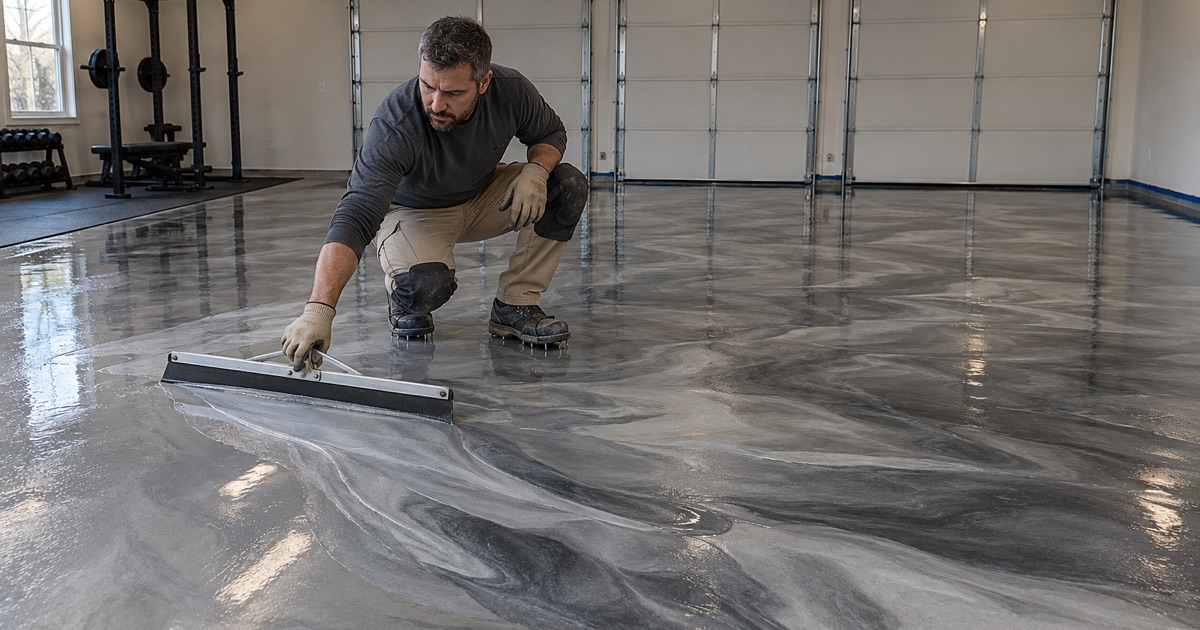
Bolingbrook Epoxy Flooring has installed decorative and industrial floors for 20+ years in Bolingbrook, IL, and our metallic epoxy floors serve surrounding cities including Lemont, Warrenville, Burr Ridge, Hinsdale and Shorewood. A metallic floor uses pearlescent pigments suspended in clear epoxy, moved by hand while wet, so the cured surface has the depth and swirl of polished stone or flowing metal.
The finish is decorative, but what decides whether it lasts is the same as on any coating: a ground slab, a moisture test and repaired cracks. A metallic floor is smooth and reflective, so every flaw underneath shows, and the preparation has to be better rather than lighter.
The proposal lists the primer, the metallic coat and the topcoat by product, with the finished thickness and price per square foot, and a sample board in your colors comes before the pour.
Commercial and Residential Metallic Floors
Showrooms, Salons and Retail Spaces
Metallic floors are popular in car showrooms, salons, boutiques and restaurants that want a finish customers notice. In those spaces we finish with a hard, ultraviolet-stable topcoat, because window light and constant foot traffic are what dull and yellow a decorative floor first.
Commercial pours are scheduled around opening hours, often overnight or across a closed weekend, with the cure time to foot traffic written into the schedule. Fixtures and furniture go back only after that point, so nothing is set down on a topcoat that is still soft.
Offices and Lobbies
In office lobbies and corridors, a metallic floor replaces tile or carpet with a seamless surface that cleans with a damp mop. Colors are usually kept to grays, silvers and bronzes that read as finished stone rather than a statement floor.
A lobby floor also has to survive winter boots. We keep a fine grit in the topcoat inside entrances and plan for walk-off mats, so the floor looks polished without becoming a slip hazard when salt slush comes through the door.
Basements and Living Spaces
In a finished basement, a metallic floor turns a gray slab into a rec room, bar or home theater floor. Because basement slabs sit below grade, the moisture test is not optional, and where readings run high a mitigation primer goes under the metallic coat.
A metallic floor is less forgiving of moisture than a flake floor, because a blister or a cloudy patch shows clearly in a smooth, reflective surface. That is one more reason the test result, not the color choice, comes first on a below-grade job.
Showcase Garages
A garage used to display a car or as a workshop can take a metallic floor well. A garage that takes salt slush every winter day is better served by flake, and we say so.
Where a homeowner wants the metallic look in a working garage anyway, we can add a fine aggregate to the topcoat and suggest mats under the wheels in winter. It changes the feel of the surface slightly, which we show on a sample before the pour.
How a Metallic Epoxy Floor Is Poured
Grinding and Repair
We grind the slab with diamond tooling to a smooth, even profile and collect the dust at the grinder. Cracks are filled and ground flush, and low spots are skim-coated, because a reflective floor shows every dip and ridge.
Before grinding we also run a moisture test, using a calcium chloride test or in-situ relative humidity probes. A metallic floor is often the most expensive finish in the house per square foot, and finding a damp slab after the pour is the costliest way to learn about it.
Primer and Base Color
A primer seals the concrete so air does not rise out of the slab and leave pinholes in the metallic coat. A tinted base coat follows, chosen to sit under the metallic layer and set the overall tone.
The base color does more work than most people expect. A dark base deepens the contrast in the veining, while a light one makes the pearlescent pigment glow, so we test the combination on the sample board before choosing.
The Metallic Coat
The metallic epoxy is mixed in batches, poured and spread, then worked with rollers, brushes, air or solvent sprays to move the pigment. The installer has a limited working time set by the slab temperature, so the floor is laid out in sections planned before mixing starts.
Humidity matters as much as temperature. High humidity on a cool slab can leave amine blush, a waxy film on the surface of curing epoxy that weakens the bond of the next coat, so we read the dew point spread before the pour and wash and check the surface before the topcoat.
Topcoat
Once the metallic coat cures, a clear topcoat of polyurethane or polyaspartic adds scratch resistance and ultraviolet stability. A fine grit can be added where the floor needs more traction.
The topcoat is also the layer that gets renewed later, so we choose one that can be scuff-sanded and recoated. That keeps the decorative layer underneath protected for the life of the floor.
Choosing Colors and Effects
Single and Blended Colors
A single metallic color gives a subtle, cloudy movement, while two or three blended colors produce bolder veining. We make a sample board in your colors under your own lighting, since pearlescent pigments shift with light angle.
The board shows the color family and the movement, not an exact preview. Every metallic floor is worked by hand, so the finished pattern is unique to your room, and we would rather say that up front than promise a copy of a photo.
Marble, Lava and Ocean Effects
Different techniques create different looks: tight veining that reads like marble, wide cells that look like lava, or long drifting patterns that look like water. The effect is chosen before the pour so the crew can plan the sequence.
Borders and Logos
Borders, saw-cut lines and logos can be built into a metallic floor, which works well in showrooms and lobbies. We plan the layout around control joints so they become part of the design.
A logo or border is laid out and masked before the metallic coat, then the mask is pulled at the right stage so each color holds a clean edge. Logos in a lobby or showroom need a little more lead time, since the artwork is scaled and positioned on the slab before the pour day.
What a Metallic Floor Costs
Pricing per Square Foot
Metallic floors are priced per square foot, and they usually sit above flake systems because they take more material, more layers and more hand work. The size and shape of the room matter too: a small, broken-up space with many corners takes more labor per square foot than an open floor.
Repair, skim coating, a moisture-mitigation primer where testing calls for one, and the choice of topcoat all show up as separate lines in our proposal. That way you can see what the decorative finish itself costs and what the slab needs regardless of the finish.
Matching the Finish to the Room
If the budget is tight or the room takes hard use, a flake floor or polished concrete may serve better, and we will tell you. A metallic floor is worth it where people will stand and look at it, such as a showroom, a bar or a finished basement, rather than where it will mostly be driven on.
Care and Long-Term Wear
Daily Cleaning
Dust mop daily and damp mop with a neutral cleaner, because grit dragged across a gloss floor is what dulls it. Walk-off mats at entrances catch most of the sand and salt before it reaches the floor.
Recoating the Topcoat
High-traffic metallic floors eventually show wear in the topcoat, not the metallic layer. A light sanding and a fresh topcoat restore the shine without redoing the decorative coat underneath.
How often that is needed depends on traffic. A residential basement may go many years before a recoat, while a busy salon or showroom entrance shows wear sooner, and we can point out the early signs so the topcoat is renewed before the metallic layer is exposed.
Warranty and Moisture
Coating warranties usually exclude damage from moisture rising through the slab, which is why we test before pouring. We read the exclusions out before you sign, starting with moisture.
VOC Rules in Illinois
Metallic epoxy, primers and topcoats are all chosen within the Illinois VOC limits for floor coatings. That rule binds the installer as well as the manufacturer, so we do not thin products beyond their labels to stretch working time.
- 20+ Years Coating Concrete
- Moisture Testing in Every Scope
- Free Written Estimates