
Bolingbrook Epoxy Flooring installs ESD flooring in Bolingbrook, IL, bringing 20+ years of floor coating work to electronics assembly, labs, data rooms and other static-sensitive spaces, and serving surrounding cities including Lemont, Warrenville, Burr Ridge, Hinsdale and Shorewood. An ESD floor is a coating system built to carry static charge away from people and equipment to ground within a specified resistance range.
That range is the specification, and it is the thing we measure. We install conductive primers, grounding points and a static-dissipative or conductive topcoat, then test resistance across the floor after it cures and hand over the readings, so the result is documented rather than claimed.
Like every coating we install, an ESD floor starts with mechanical preparation and a moisture test. A conductive system that delaminates is not only a failed floor but a broken grounding path, so the basics matter even more than usual.
How ESD Floors Work
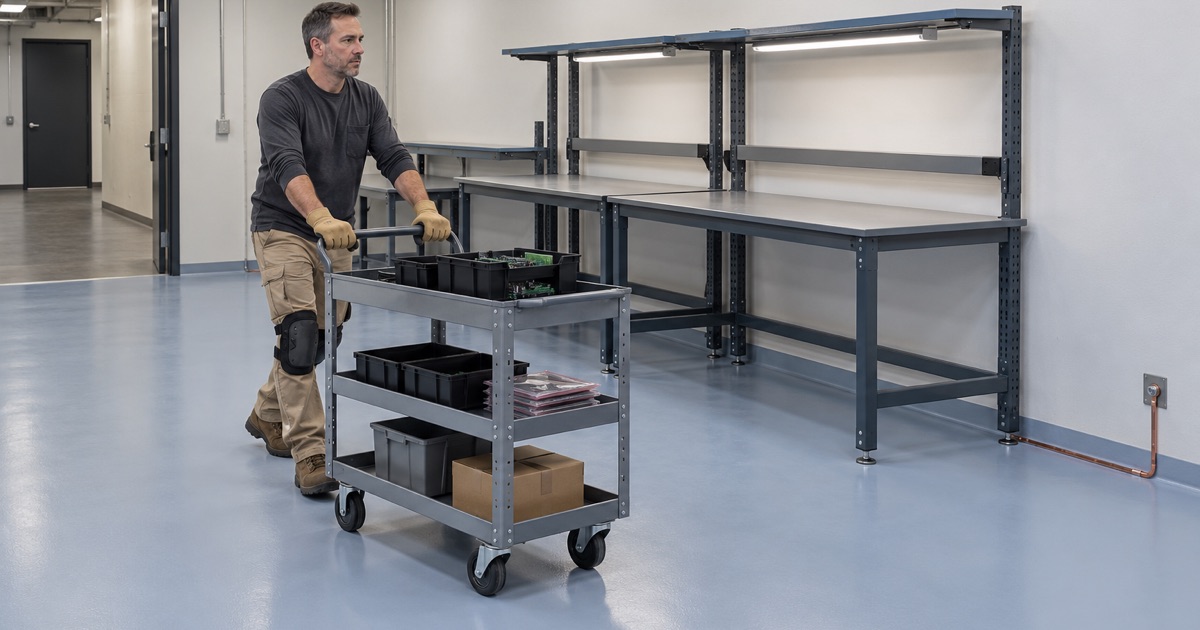
Static Charge and Why It Matters
People build up static charge as they walk, especially on insulating floors in dry winter air. A discharge too small to feel can damage sensitive electronic components, or cause problems in labs and around certain equipment.
An ESD floor gives that charge a controlled path to ground. When paired with conductive footwear or heel straps, it keeps people from building up charge as they move around the space.
Conductive and Static-Dissipative Systems
Conductive floors have a lower resistance and drain charge quickly. Static-dissipative floors have a higher resistance and drain it more slowly and in a more controlled way. The right choice depends on the devices handled and the program your facility follows.
We work from your specification or your ESD coordinator’s requirements, and the proposal names the target resistance range and the test method we will use to confirm it. If the specification changes during the project, the proposal is revised before work continues.
The Floor Is Part of a System
The floor works with footwear, wrist straps, grounded benches and procedures. A floor that meets its resistance range will not protect parts if people wear insulating shoes, so we review the whole grounding path with you before choosing the system.
How We Install ESD Flooring
Preparation and Moisture Testing
We diamond grind or shot blast the slab to the profile the system requires, collecting dust at the machine, and repair cracks and joints. The slab is tested for moisture with calcium chloride kits or in-situ relative humidity probes, and a mitigation primer is specified if needed.
Grounding Points and Conductive Layers
Copper grounding strips or grounding points are placed on the slab and connected to the building ground by an electrician. A conductive primer or layer then ties the whole floor area to those points.
The layout of grounding points depends on the room size and the system maker’s requirements. We plan it before work starts so connections are ready when the coating goes down.
ESD Topcoat
The static-dissipative or conductive topcoat is applied over the conductive layer at the thickness the system requires. Film thickness matters, because a coat that is too thick can push resistance outside the range.
Resistance Testing
After curing, we test resistance point to ground and point to point across the floor with a calibrated meter, following the method named in your specification. Readings are recorded on a floor plan and handed over at completion.
Where ESD Floors Are Used
Electronics Assembly and Repair
Electronics assembly, repair and testing areas are the most common ESD floors. The floor supports a wider ESD program that also covers workstations, packaging and handling.
Data Rooms and Server Spaces
Data rooms and server spaces use ESD flooring to limit static around equipment. These rooms often have raised floors in some areas and slab floors in others, and we coat the slab areas.
Labs, Clean Areas and Specialty Spaces
Labs and some manufacturing rooms need a seamless, cleanable floor that also controls static. ESD systems can include integral cove bases for easier cleaning.
Keeping an ESD Floor in Range
Cleaning Products
The wrong cleaner leaves a film that insulates the floor and raises resistance. We provide the coating maker’s approved cleaners and instructions, and recommend avoiding waxes and finishes.
Periodic Testing
Resistance should be checked periodically as part of the facility’s ESD program, especially in high-traffic areas. If readings drift, cleaning or a fresh topcoat usually brings the floor back into range.
VOC and Ventilation
ESD coatings are chosen within the Illinois VOC limits, which bind the installer as well as the manufacturer. We schedule installation around the facility’s hours and ventilate the space until the coating has cured.
Planning an ESD Floor Project
Working From Your Specification
Most ESD floors are installed to a specification written by the facility, a parent company or a customer the facility supplies. We read that document first and quote the system that meets it, including the resistance range, the test method and any requirements for body voltage generation testing with your footwear.
Where there is no written specification, we work with your ESD coordinator or quality lead to define one before work starts, so the floor is measured against an agreed number. That number then appears in the proposal and in the test report at handover.
Coordinating With Your Electrician
The grounding points are connected to the building ground by a licensed electrician, usually yours. We mark the locations before the floor is coated and coordinate the timing, so connections are ready and tested when the conductive layer goes down.
Scheduling Around Production
ESD areas are usually working production or data spaces. We schedule grinding and coating during shutdowns, weekends or overnight shifts, and protect adjacent equipment from dust with sealed barriers and vacuum collection at the grinder.
Expanding or Repairing an ESD Floor
When a facility adds a line or a room, new ESD flooring has to tie into the existing grounding system. We test the existing floor first, then plan the new area so the resistance stays consistent across the transition.
Damaged areas can usually be repaired by grinding out the damaged section, restoring the conductive layer and recoating, followed by a resistance test across the repair. The readings for the repaired area are added to the floor’s existing test records.
- 20+ Years Coating Concrete
- Moisture Testing in Every Scope
- Free Written Estimates